Wedding Culture & Planning · Cameraboss Blog
The Igbo Traditional Wedding in the UK: What Happens, What to Plan For, and How to Capture Every Moment
There is a moment at every Igbo traditional wedding that stops time. A young woman in brilliant George fabric and coral beads — carrying a calabash of palm wine — dances slowly through a crowd of hundreds, eyes searching. The room holds its breath. Guests sway in front of the groom, laughing, trying to confuse her. When she finds him, kneels, and offers the cup, the entire space erupts in ululation and dancing. That single act is the Igba Nkwu. It is the heart of the Igbo wedding. And if your photographer does not know it is coming — if they do not understand what they are watching — they will miss the most important frame of your day.
At Cameraboss, we have had the extraordinary privilege of documenting Igbo weddings across the UK — in London, Birmingham, Manchester, Leicester and beyond. Here is everything you need to know about the Igbo traditional wedding, and why the cultural literacy of your photographer is not a bonus. It is the job.
What Is the Igbo Traditional Wedding?
The Igbo traditional marriage is formally known as Igba Nkwu Nwanyi — which translates, beautifully, as “wine carrying.” It is one of the most visually and emotionally layered celebrations in West African culture. Unlike the more structured, Alaga-led Yoruba engagement ceremony — where a professional MC controls the entire timeline — the Igbo traditional wedding moves to a different tempo: warm, communal, and building towards one magnificent centrepiece moment.
For Igbo couples marrying in the UK, the celebration rarely happens in isolation. It unfolds across a full weekend: the Ime Ego (the bride price and introductory ceremony) typically takes place on one day, followed by the main Igba Nkwu, and then the white wedding. Each element carries its own visual world, its own emotional register, and its own photography demands. Understanding this is not something your photographer can learn on the day. We explore how the full Nigerian wedding weekend unfolds in our broader guide, the Nigerian wedding weekend explained.
The Ceremonies: What Actually Happens
Ime Ego — The Bride Price & Introductory Ceremony
The Ime Ego is the formal meeting of both families: the groom’s people come bearing gifts, a formal list of items requested by the bride’s family (known in some dialects as ihe ọmụmụ), and the intention to negotiate and finalise the bride price. It is conducted through spokespeople on each side, with the Oji (kola nut) cracked, prayed over and shared as a sign of communal blessing and ancestral acknowledgement. The mood swings between reverent and riotously funny — and a photographer who can hold both registers, reading the room, is worth their weight.
Igba Nkwu — The Wine Carrying Ceremony
This is the centrepiece of the Igbo traditional wedding. The bride — dressed in her finest George fabric, layers of coral beads at her neck, wrists and head, and often a hand-woven crown or elaborate fascinator — is handed a calabash cup of palm wine by her father or a senior male relative. She then dances through the assembled guests, searching for her groom. The crowd deliberately tries to confuse and obscure him. When she finds him, she kneels before him, takes a sip, and presents the remaining wine. His acceptance of the cup is the act that seals the marriage in the eyes of their community and their ancestors.
This sequence must be anticipated, not reacted to. Your photographer needs to know the room layout, where the groom will be seated, when the bride enters, and how the procession moves. The approach, the kneel, the cup, the eruption — these are unrepeatable frames.
The White Wedding
Many Igbo couples in the UK hold their church service and evening reception on a separate day. The white wedding is its own world — with its own light, its own timeline, and its own emotional arc. Thoughtful Igbo couples often weave cultural details into the white wedding day: coral beads on the bride beneath her gown, a fabric sash in the George colour palette for the bridal party, an Oji toast at the reception. These moments call for a photographer who moves fluidly between tradition and modernity without missing a beat.
Colours, Fabrics and the Visual Language of an Igbo Wedding
Igbo weddings are a feast for the eye. While Aso Ebi — coordinated family fabrics — creates the celebratory sweep of colour across the crowd, the bride herself is the centrepiece of a distinct visual tradition.
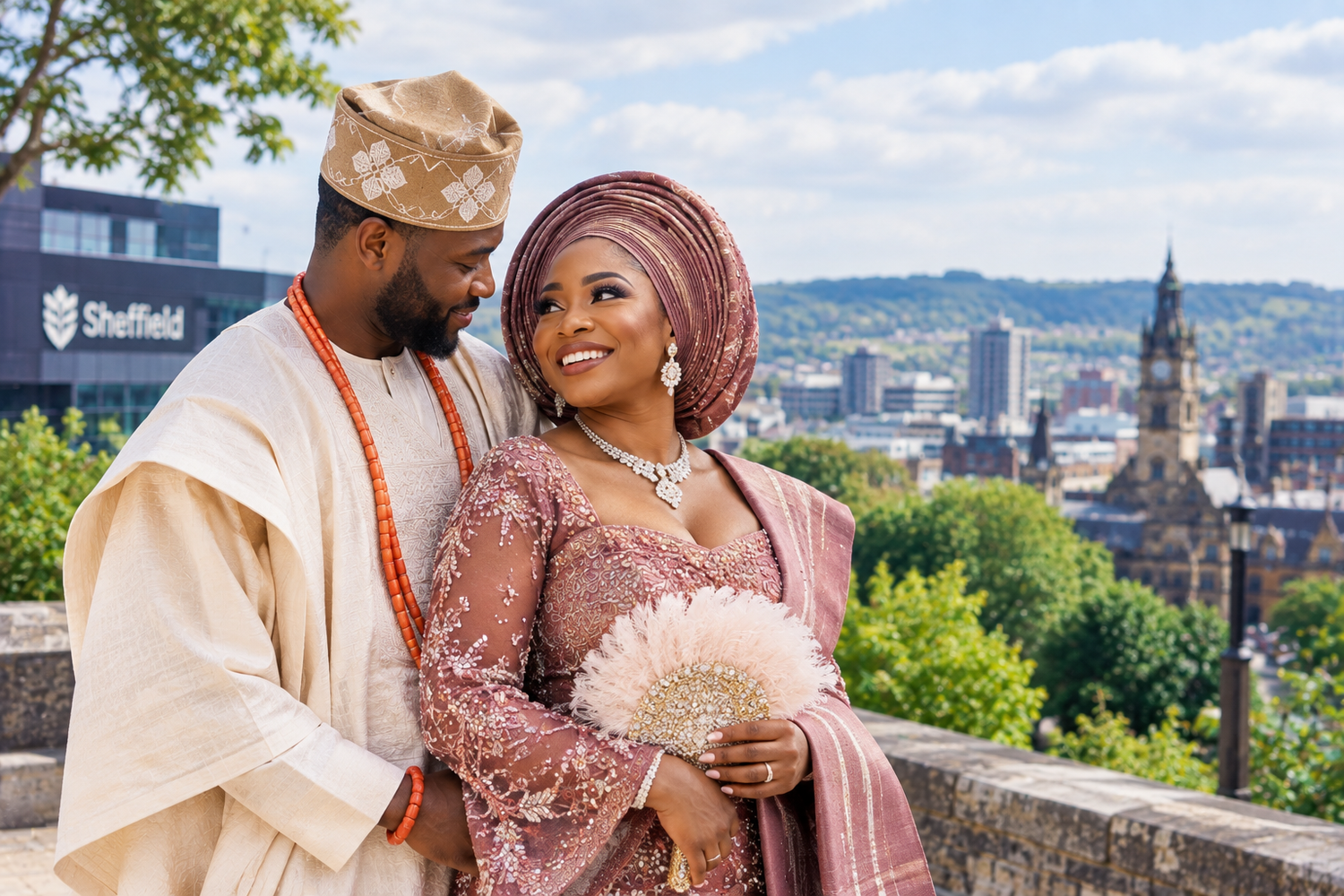
Igbo brides traditionally wear George fabric: a rich, woven textile originating from the Niger Delta region, available in a luminous range of tones — deep royal blue, forest green, burgundy, terracotta and gold. This fabric catches light beautifully but requires a photographer who exposes carefully for warm brown skin tones, ensuring the coral and gold beadwork retains its detail rather than blowing out into glare.
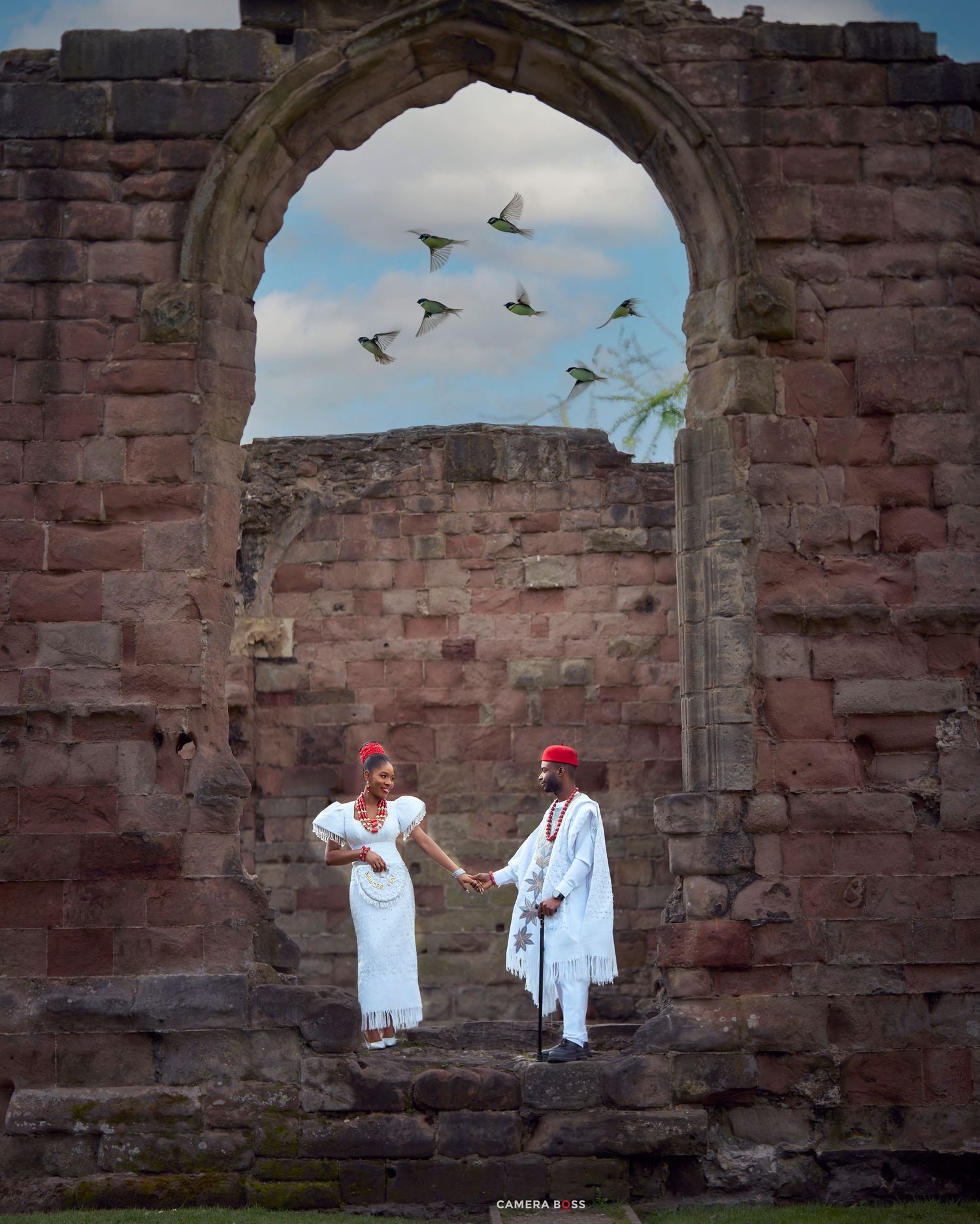
Grooms wear the iconic Isiagu: a patterned tunic featuring a lion’s head motif, typically in rich burgundy, black or navy, paired with a red chieftaincy cap and ivory accessories. The visual richness of an Igbo ceremony is extraordinary in any light condition — and in the UK, where many receptions take place in banquet halls or hotel ballrooms, artificial light management is everything.
At Cameraboss, our background as a fine art photographer — exhibited at Boomer Gallery in London and Atirira Gallery in Lagos — means we approach every Igbo wedding with the same editorial eye we bring to gallery work. Colour, light, texture and cultural meaning are never an afterthought. They are the foundation of every frame.
Planning Your Igbo Wedding in the UK: What to Build Into Your Timeline
Igbo weddings run long — beautifully, joyfully, unpredictably long. The Ime Ego alone can run two to three hours when the families are in full celebratory form. The Igba Nkwu, with its dancing, wine search, speeches and family presentations, can stretch across the afternoon. If you are combining a traditional ceremony with a white wedding the following day, you are looking at a full weekend of coverage.
Build generous time into every stage of your planning. Venue arrivals should be early: whether you are celebrating at a banquet hall in London, Birmingham, Leicester or Manchester, your photographer needs time to walk the room, understand the light, and position themselves for the bride’s wine-carrying entrance before it begins. Our comprehensive guide to planning your wedding day photography timeline gives you the exact framework for this.
Cameraboss covers Igbo and Igbo-fusion weddings across the whole of the UK. You can view all the locations we serve here, and if you are considering adding videography to your weekend coverage, our guide to wedding videography in 2026 is worth a read.
Frequently Asked Questions
Is the Igbo traditional wedding the same as a Yoruba engagement ceremony?
No — while both are Nigerian traditional ceremonies, they have distinct rituals, roles and visual languages. The Igba Nkwu wine-carrying moment is uniquely Igbo. The Yoruba ceremony is led by an Alaga and structured differently. Your photographer needs to understand the specific tradition you are celebrating, not apply a generic “Nigerian wedding” approach. We have documented both extensively across the UK.
Can one photographer cover both the Igbo traditional ceremony and our white wedding?
Absolutely — and we strongly recommend it. A single photographer (or Cameraboss team) across your full weekend creates visual continuity and a richer narrative story from Ime Ego to the white wedding reception. You can explore our full weekend packages on our pricing page.
What should I tell my photographer before the Igba Nkwu?
Give your photographer a complete run of ceremony — who hands the bride the cup, where the groom will be seated, which direction the bride will enter from, whether there are processions or family arrivals that need documenting first. Brief your photographer as you would brief your MC. The difference between a photographer who knows the sequence and one who is guessing is visible in every single gallery.
Do I need a second shooter for an Igbo wedding?
For most UK Igbo weddings — particularly those with a large Igba Nkwu guest list and a full white wedding weekend — a second shooter is strongly recommended. The wine-carrying moment is intimate and close-range; a second position captures the crowd’s reaction simultaneously. We discuss this with every couple at enquiry stage.
If you are planning an Igbo traditional wedding in the UK — a single ceremony, a full weekend, or a fusion celebration that weaves Igbo tradition into a contemporary setting — the right photographer does not simply show up with a camera. They arrive knowing your language, your rituals, your fabrics and what is about to happen next. That is what Cameraboss brings to every Igbo celebration we are trusted to document.
You might also enjoy reading about how we approached the full cultural weekend in our story of Joanna & Jonathon’s Anglo-Nigerian wedding at Beamish Hall, or our guide to choosing a wedding photographer as a Nigerian or African couple in the UK.
Ready to Talk About Your Igbo Wedding?
We would love to hear about your celebration — which ceremonies you are planning, where in the UK you are marrying, and how we can serve you. Spaces for 2026 and 2027 are filling. Reach out and let’s begin.