Most venue guides written for Nigerian couples quote capacity figures that turn out to be wrong, and none of them explain the one rule that actually decides where you can hold each of your two ceremonies. This is a working photographer’s version — real numbers checked against the councils’ own registers, and the practical constraints that only show up after you’ve signed.
Top Nigerian Wedding Venues in Manchester for Large & Luxury Celebrations
What a Nigerian wedding actually asks of a Manchester venue
A Nigerian wedding is not one event, and that single fact reshapes the entire venue search. You have a traditional engagement — the Yoruba idana or its Igbo, Hausa or Edo equivalent — and then a white wedding or civil ceremony, often on separate days and frequently in separate buildings. Two venues, two sets of logistics, two deposits.
Then there is scale. A Manchester Nigerian wedding routinely runs to 300 guests and often past 500 once extended family and aso-ebi groups are counted, which immediately eliminates the majority of the city’s wedding venues. And the guest list is only half the space problem, because a Nigerian celebration needs floor as much as it needs seats: a live band or DJ setup, a dance floor that stays busy for hours, and clear room around the couple for spraying.
This is where published capacity figures mislead badly. A venue quoting “500” usually means 500 seated for dinner in a room laid out entirely with round tables. Take out a band, a proper dance floor and circulation space for spraying, and the same room comfortably holds 350. I have photographed weddings where the venue’s own number was technically correct and the room was still visibly too small by seven o’clock.
The other three constraints worth naming now, because they eliminate venues faster than capacity does: whether external caterers are permitted, what time the music has to stop, and whether the room has a noise limiter. Nigerian catering is non-negotiable for most families, and a venue that insists on in-house catering is simply not an option regardless of how it looks.
The licensing rule that quietly decides your options
Here is the thing almost no venue guide explains, and it widens your choices enormously once you understand it.
A traditional engagement is a cultural ceremony, not a legal one. No registrar attends, nothing is signed into law, and therefore it does not need to happen in a licensed venue at all. Any hall, warehouse, marquee or event space in Greater Manchester can host your engagement. That single fact opens up dozens of large, affordable spaces that never appear in wedding venue directories because they aren’t licensed for marriage.
Your legal ceremony is different. To marry legally you need an approved premises, a register office, or a religious building registered for marriage. Approved premises are licensed by the local council, not nationally, and Greater Manchester is split across ten of them — which catches couples out constantly.
Venues inside the city boundary appear on Manchester City Council’s licensed venues register, which lists well over fifty. But several of the biggest spaces couples want — Victoria Warehouse, the Old Trafford stadiums, Hotel Football — sit in Trafford, and are handled entirely separately through Trafford Council’s approved premises list. Different council, different registrar booking, different fees, booked separately from the venue itself.
The strategy most Manchester Nigerian couples land on: hold the legal ceremony somewhere small and licensed, then put the money into one enormous space for the engagement and reception. It is cheaper, and removes the licensing constraint from the decision that matters most.
The large-capacity venues — verified numbers
These are the Greater Manchester spaces that genuinely handle 400 guests and above. Every figure below is taken from the venue’s own published information or the relevant council register rather than from other venue round-ups.
- Victoria Warehouse, Trafford Park (M17 1AB). The biggest realistic option. Overall capacity spans 120 to 3,500 across the building, with five rooms licensed for civil ceremonies through Trafford Council. The Cotton Sheds takes ceremonies up to 1,000 and dining up to 700; The Bays handles ceremonies to 300 and dining to 260. An early-1900s cotton warehouse, so raw brick and steel — a blank canvas you dress rather than a room that decorates itself.
- BEC Arena / Bowlers, Trafford Park. An exhibition centre rather than a wedding venue, which is exactly why it works for very large celebrations. Capacity runs from 300 to 4,500, with a pillar-free main floor of roughly 2,960 square metres across five halls and seven bars. Pillar-free matters more than it sounds: it means no guest has an obstructed view of the couple, and no photographer has to shoot around a column.
- The Monastery, Gorton. Grade II* listed Victorian Gothic on Gorton Lane and the most beautiful large room in Greater Manchester. It handles 50 to 550, with the Great Nave seating up to 400, a private chapel for 40 and a healing garden taking around 80 for an outdoor ceremony. Licensed by Manchester City Council.
If your number is genuinely above 550 and you want the celebration in one room, the honest shortlist is Victoria Warehouse or BEC Arena. Everything else in Manchester requires splitting your guests across spaces.
The luxury end — and a capacity myth worth correcting
Several guides currently circulating claim Manchester Hall handles up to 500 guests. It does not, and booking on that basis would be an expensive mistake.
Manchester Hall — the restored 1920s Freemasons Hall at 36 Bridge Street — is genuinely one of the most striking interiors in the city, all marble, dark wood and art deco detail. But the council’s own register of approved rooms lists its two largest as Goulburn Dining and John Rylands, each at a maximum of 350, with the Gallery, Museum, Goulburn Lodge and Garden Court at 150 apiece and the remaining rooms between 20 and 70. Three hundred and fifty is the ceiling in any single room, and that is a ceremony occupancy figure rather than a seated-dinner one.
The Whitworth is the other genuine luxury option and smaller still — its Jacobean-style Grand Hall takes 200. After a £15 million redevelopment it has the best natural light of any venue in the city, which for photography is worth a great deal.
So the real luxury decision for a large Nigerian wedding in Manchester comes down to this: the Monastery gives you a spectacular room that needs almost no styling but caps you at 400 seated, while a warehouse gives you unlimited scale and a blank shell you must spend serious money dressing. There is no venue in this city that offers both. Couples who understand that early make a much better decision than couples who discover it in month four.
What these rooms actually do to your photographs
This is where venue choice stops being a planning question and becomes a photography one, and it is the part I care most about.
Warehouse and arena spaces are dark. Victoria Warehouse and BEC Arena have no meaningful daylight in the main halls, so everything you see in the photographs is light somebody brought in — usually coloured LED uplighting, often changing during the reception. Mixed and shifting colour temperature is the single hardest technical problem at a large Nigerian wedding, and it is why some galleries come back with orange faces in the evening frames. It is solved by grading each lighting state separately rather than pushing one preset across the set.
The Monastery is the opposite problem: enormous contrast, light dropping from high windows onto dark stone, with a lit face and deep shadow two feet apart. You expose for the face and let the stone go, and anyone trying to light the whole nave has misunderstood the room.
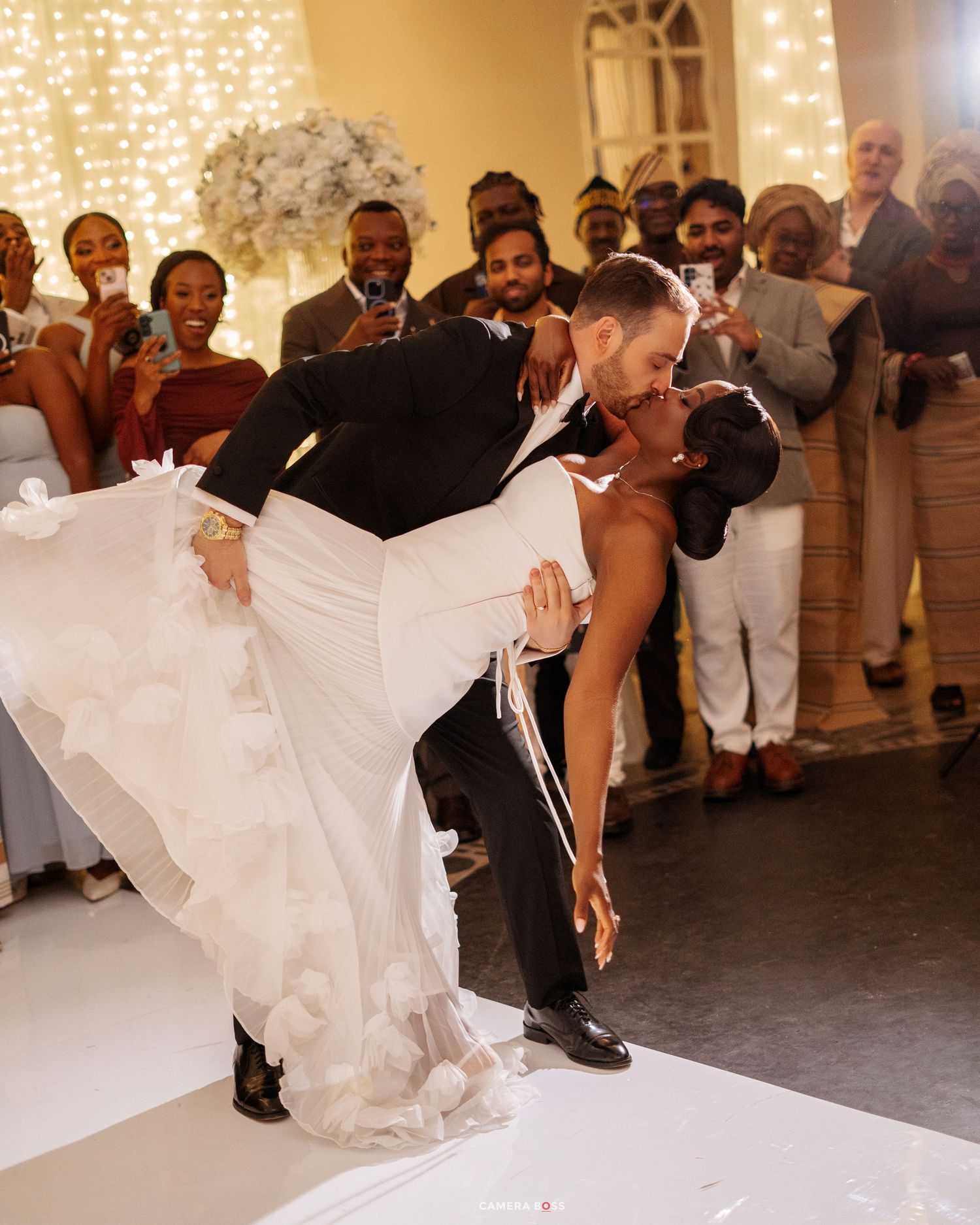
Then there is spraying, which is fast, unpredictable and the most photographed moment of any Nigerian wedding. Notes in the air, hands moving, people stepping in and out of frame from every direction. It needs a high shutter speed, it needs the photographer already positioned rather than pushing through the crowd, and it needs someone who knows it is coming.
I’m John Lekan — a British-Nigerian luxury and documentary wedding photographer, and Creative Photographer of the Year at the Creative Industry Awards 2024. Knowing the running order isn’t cultural decoration — it is the difference between standing in the right place before the prostration and turning round a second after it. The other half is technical: a camera metering a white dress and darker skin together will protect the dress and lose the face on default settings, and in a dark warehouse that gap widens considerably. We expose and grade for the people in the room. You can see how that reads across our traditional ceremony work and our wider wedding galleries, and for celebrations carried by drumming and dancing, wedding film earns its place here more than almost anywhere.
Six questions to ask before you sign anything
Ask these on the first call. Each one has ended a venue search for a couple I’ve worked with.
- “Can we bring our own caterer, and do they get kitchen access?” Permission to bring external catering is worth little without a kitchen, water and power. Ask about both, and about any surcharge.
- “What time does music have to stop, and is there a noise limiter?” A limiter that cuts power when volume passes a threshold is incompatible with live drumming, and this is discovered on the night far more often than it should be.
- “What is your policy on spraying?” Some venues are entirely relaxed; others apply a cleaning charge. Neither is unreasonable, but you want it in writing.
- “Is that capacity seated, or seated with a dance floor and band?” The gap between the two answers is often 150 guests.
- “Is this room licensed for the ceremony, or only the reception?” Cross-check against the council register — and confirm which council. The registrar is booked separately from the venue.
- “How many cars can you park?” Trafford Park venues are strong here; city-centre ones are not, and 400 guests driving into central Manchester on a Saturday is a genuine problem.
If you are still at the legal stage, the notice requirements are set out plainly at GOV.UK. Manchester is one of the cities we cover without a travel surcharge — the full list is on our areas we cover page, and coverage tiers are on the pricing page.
Common Questions
A: Realistically Victoria Warehouse or BEC Arena, both in Trafford Park — they are the only spaces in the area that take 500 comfortably in one room with a band and dance floor. The Monastery is more beautiful but caps at around 400 seated in the Great Nave.
A: No. A traditional engagement is a cultural ceremony rather than a legal one, so it can be held in any suitable space. Only your legal marriage needs approved premises, a register office or a registered religious building.
A: At some venues yes, at many no — and it is the fastest way to narrow a shortlist. Ask on the first call, and confirm kitchen access and any external catering surcharge, not just permission in principle.
A: Because some quote seated dining, some quote standing, and councils publish a separate ceremony occupancy per approved room. Manchester Hall, for example, is often listed at 500 when its largest approved rooms are capped at 350.
A: Yes — both the traditional engagement and the white wedding, across Manchester, Trafford and the North West. Travel is built into the package rather than added afterwards.
Planning a Nigerian wedding in Manchester?
Tell me your venue, date and guest number and I’ll tell you honestly how that room behaves — the light, the space around the couple, where the spraying happens. Happy to send a full gallery from a wedding like yours.